
Switchable liquid crystal film is a flexible material with unique optoelectronic properties. It consists of transparent conductive films as the top and bottom substrates—with the conductive layers facing each other—and a middle layer of Polymer Dispersed Liquid Crystal (PDLC). By adjusting an applied AC voltage, the film’s light-transmission state can be altered: it appears translucent (frosted) when powered off and becomes colorless and transparent when powered on. Furthermore, within a specific voltage range, the transparency increases as the voltage rises.
The Ultra-high-transparency Switchable Film is the third generation of such technology developed by our company. It utilizes a conductive substrate with superior light transmission, combined with high-performance liquid crystal materials. Compared to our second-generation high-transparency film, this version offers higher light transmission in the “on” (transparent) state, lower haze, and an improved viewing angle. The ultra-high-transparency liquid crystal film (hereinafter referred to as “switchable film”) is non-adhesive on both sides; it can be laminated between sheets of flat glass using EVA interlayers to create switchable laminated glass, or it can be fitted with an adhesive layer (AB glue) on one side to produce a self-adhesive version of the film.
The ultra-high-transparency switchable film features a multi-layer composite structure. Its transparent conductive substrate consists of an optical-grade PET film coated with indium tin oxide (ITO). Two such conductive films are positioned with their conductive surfaces facing each other. A PDLC (polymer-dispersed liquid crystal) material is sandwiched between these two conductive films, bonded firmly to the ITO coatings in an inseparable manner. A protective film is applied to the outer surfaces of the conductive films; this protective layer must be removed before use and must not be included when the film is laminated into glass.
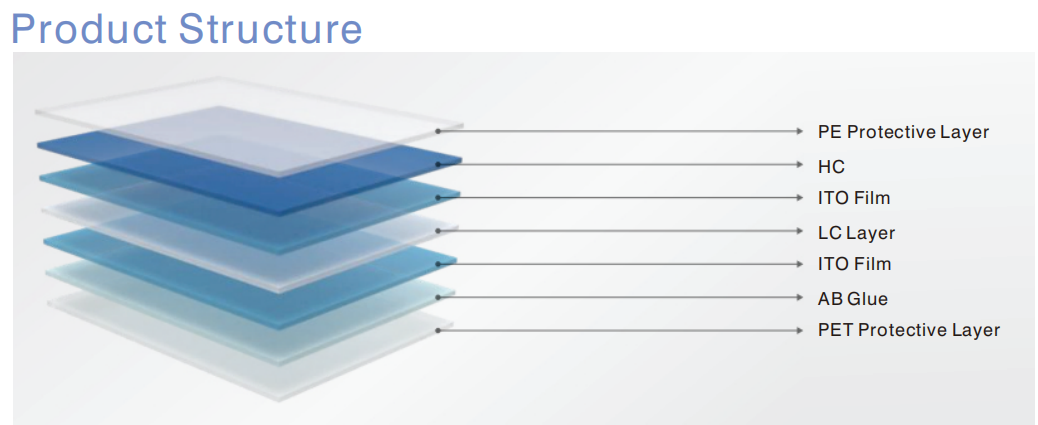
We can provide both roll and sheet products to meet our customers’ requirements. Our ultra-high-transparency switchable film sheets are cut from rolls; dimensions can be customized according to customer specifications, provided they fall within the maximum width/size limits of the original roll.
Switchable Film requires the fabrication of electrodes before it can be powered. A pair of electrodes is attached to the ITO conductive layers of the two conductive films; there is no distinction between positive and negative terminals.
Electrode fabrication method: Remove a portion of the conductive film—along with the underlying PDLC material—from one side to expose the ITO conductive coating of the conductive film on the opposite side. Apply conductive silver paste to the surface of this exposed conductive coating, attach a strip of conductive copper foil, and finally solder a wire onto the copper foil to complete the fabrication of one electrode area. Flip the film over and repeat the same process at the corresponding symmetrical position to create the second electrode.
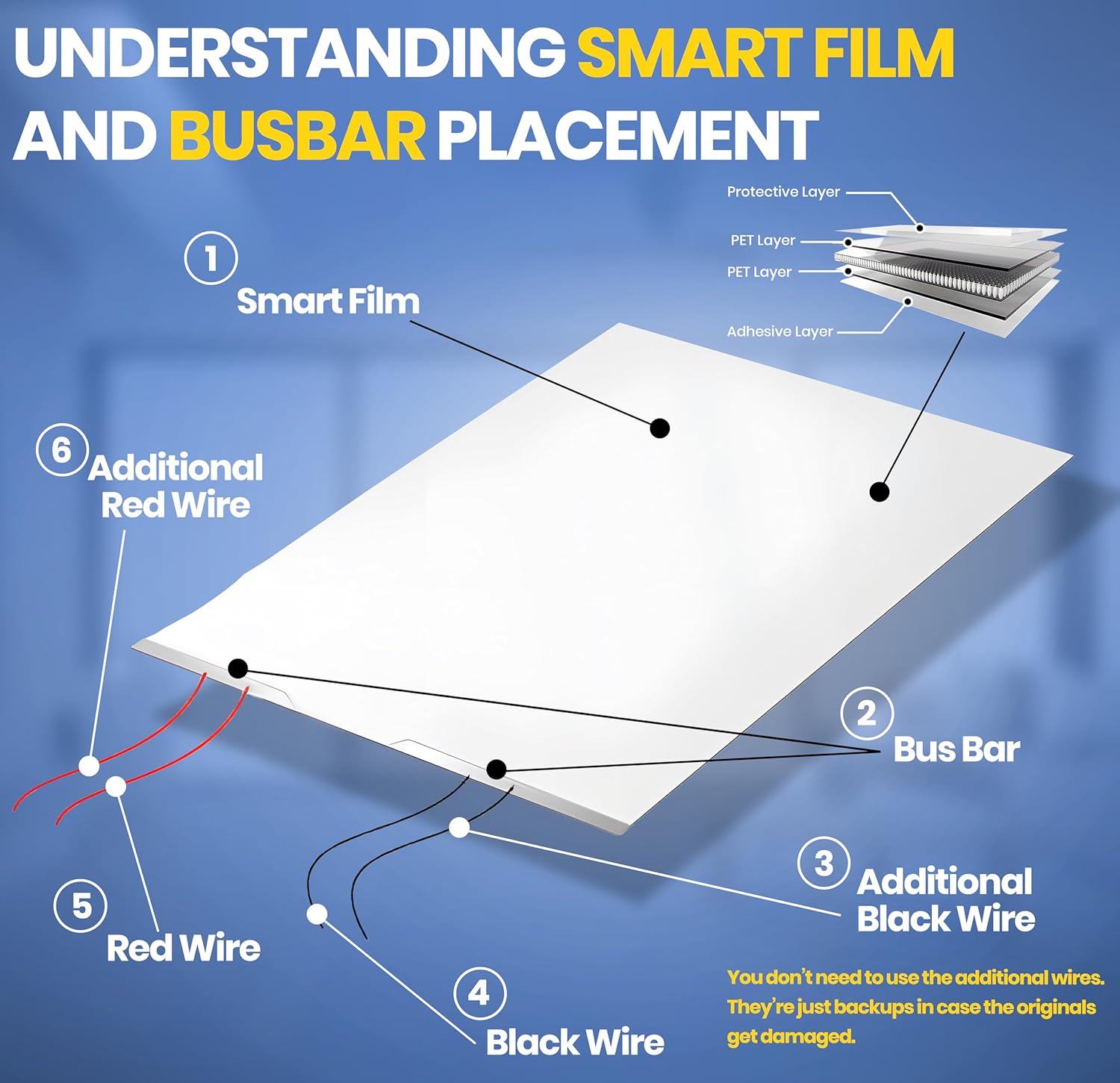
Electrode positions can be customized according to client requirements—placed on one side or both sides. Generally, it is recommended to position electrodes on both sides when the area of the switchable film exceeds 2.5 m².
Once electrode processing is complete, a transparent high-temperature-resistant tape is applied to the surface. This serves to protect the electrode edges during the lamination process and can remain on the component as it is incorporated into the laminated glass.
The appearance of the switchable film product must exhibit uniform color, haze, and light transmission. The conductive film and the PDLC material must be firmly bonded, with no signs of delamination. The interior of the product must be free from voids (areas lacking PDLC), streaks, spots, creases, black specks, dust or debris, and electrical breakdown points. The surface of the product must be free from scratches, sharp protrusions or indentations, and permanent (non-removable) colored stains.
Post time: 11 月-10-2026