
💡 Core Operating Principle of Smart Film
Smart Film is essentially an electrically controlled optical film that operates based on the principle of “molecular reorientation driven by an electric field” to switch between states of light transmission:
Powered-off state: Liquid crystal molecules within the film are arranged in a random, disordered manner. Incident light undergoes continuous refraction and scattering, resulting in an opaque, frosted appearance.
Powered-on state: Under the influence of an electric field, the liquid crystal molecules align neatly along the direction of the field. Light passes through unobstructed, resulting in a clear, transparent state.
🧪 Classification and Differences of Mainstream Smart Film Technologies
Smart Film currently on the market fall into three main categories, each based on different technical principles:
PDLC Switchable Film (Polymer Dispersed Liquid Crystal)
Structure: Liquid crystal droplets are uniformly dispersed within a polymer matrix, which is sandwiched between two conductive film layers.
Characteristics: Fast switching speed (typically 10–50 ms), high haze (light transmission <1% when powered off), and moderate cost; currently the most widely used type.
🛠️ Key Technical Parameters of Smart Film
Core indicators for evaluating Smart Film performance:
Light Transmittance: The rate of light transmission in the transparent state; our high-quality products achieve 85%–91% or higher, approaching the clarity of standard glass.
Haze: The degree of light scattering in the opaque (frosted) state; typically >90% is required to ensure privacy.
Response Time: The switching speed between transparent and opaque states (or vice versa); PDLC film typically responds in <50ms.
Service Life: Measured by the number of switching cycles; PDLC film can withstand over 10⁷ cycles.
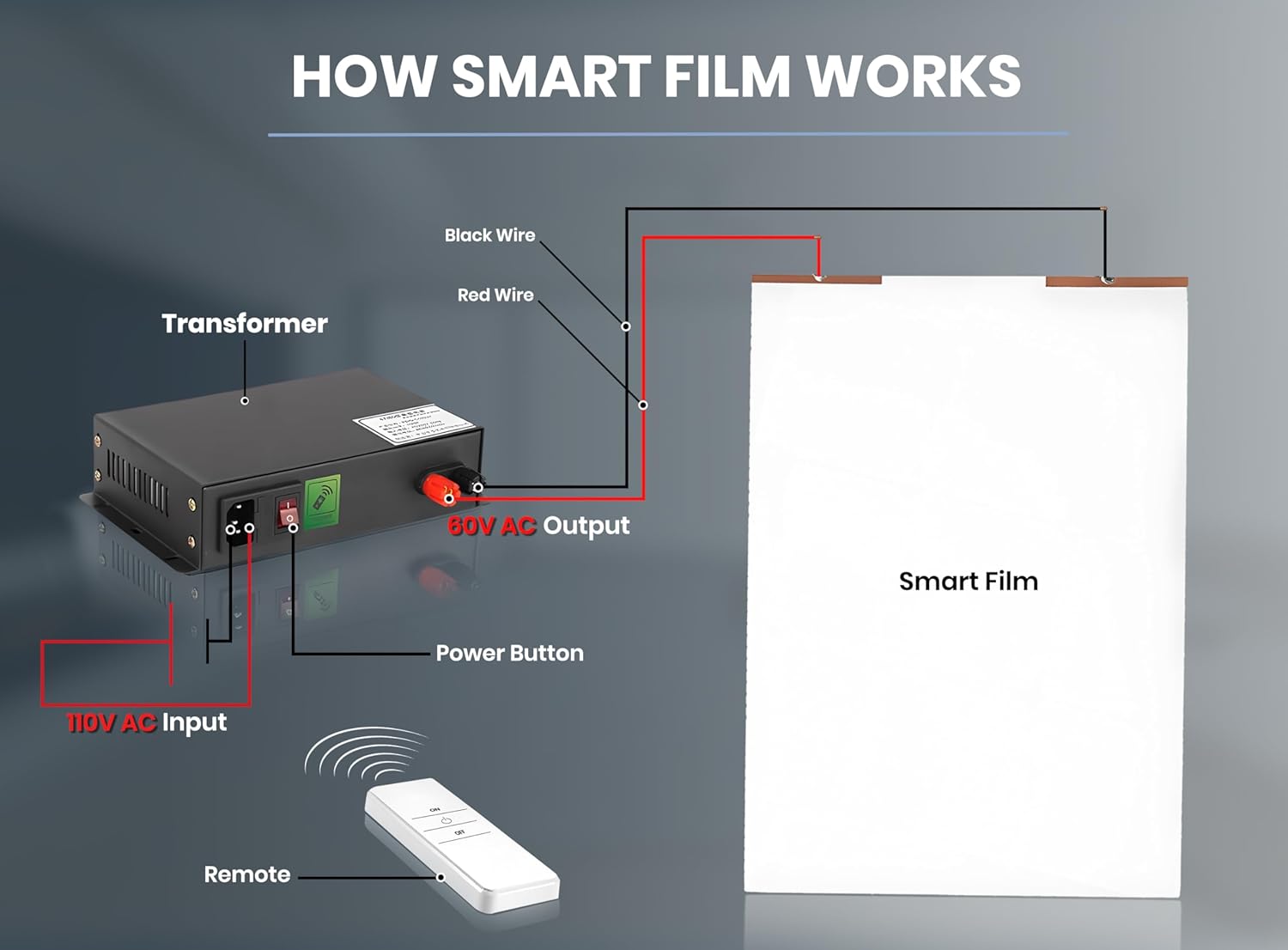
Driving Voltage: Typically AC 60V.
🏘️ Practical Application Scenarios
Leveraging the characteristics of the underlying technology, Switchable Dimming Film is widely used across various sectors:
Architectural windows and doors: Replaces traditional curtains, enabling rapid switching between privacy and natural light while enhancing the building’s aesthetic appeal.
Commercial displays: Showcases products in the transparent state and displays advertisements or conceals internal structures in the opaque state.
Office partitions: Creates flexible workspaces that can switch between open and private modes, improving space utilization.
Post time: 9 月-21-2026