
Smart Glass
Smart Glass is produced by bonding an electrically controllable film—referred to as “Switchable Transparent Film” (STF)—between two panes of glass using a dry lamination process. This product complies with national standards for laminated glass.
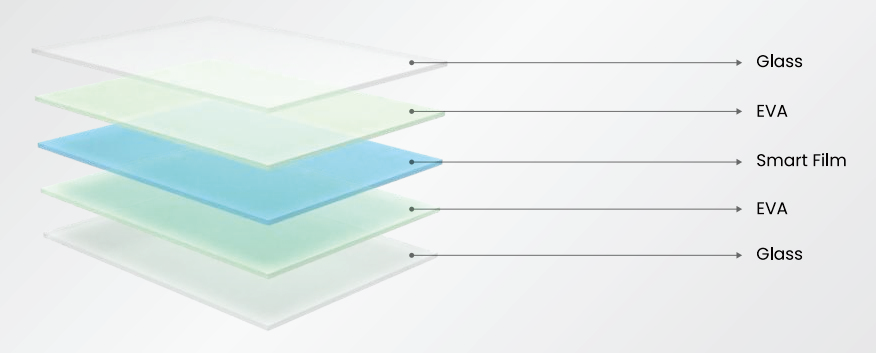
External structural dimensions:
Glass thickness + 0.76mm (EVA) + 0.4mm liquid crystal film + 0.76mm (EVA) + glass thickness.
(Glass thickness can range from 3mm to 20mm.)
Note: Available glass options include ultra-clear, standard clear, fire-resistant, Low-E, and coated glass.
Principle:
The electrically controlled film is a core technology for glass, independently developed and manufactured by our company. Products currently on the market—such as “Magic Glass,” switchable light-control glass, smart windows, smart dimmable glass, electrochromic glass, and switchable privacy (opaque-to-clear) glass—all utilize this same type of film. The glass’s ability to switch between opaque and transparent states is achieved through this electrically controlled film embedded within the glass layers.
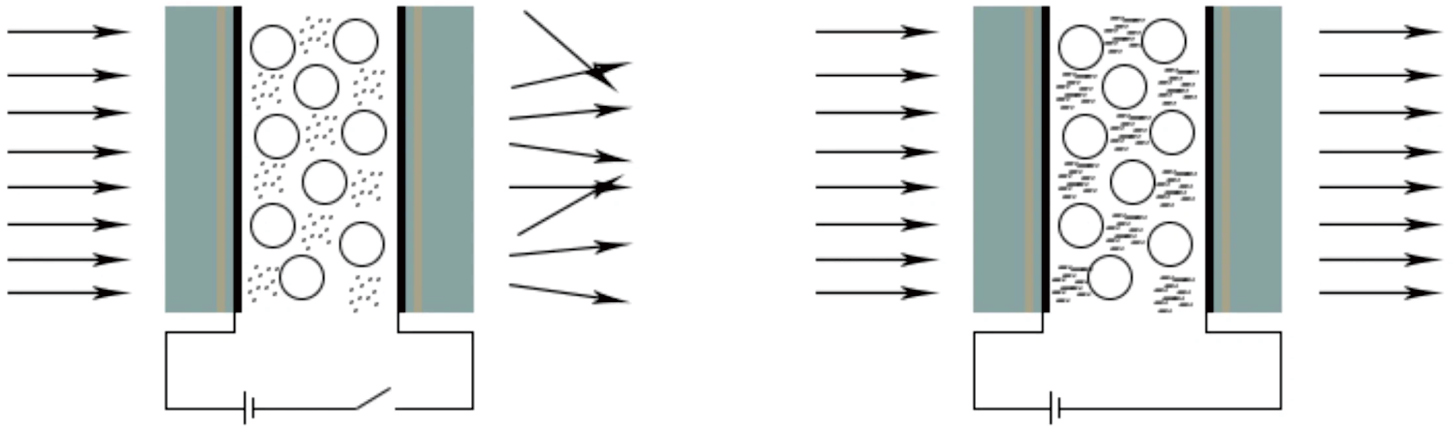
The Frosted State of the Glass
An electrically controlled film consists of a plastic-liquid crystal core layer sandwiched between two transparent conductive films. This core layer comprises liquid crystal droplets and a polymer matrix; the liquid crystal molecular directors are oriented roughly parallel to the glass substrate, with the polymer surrounding the liquid crystal droplets. This structure causes light scattering, resulting in a frosted (opaque) state for the Smart Glass.
Glass Transparency
When an external electric field is applied, an electric field is generated between the two transparent conductive films, causing the directors of the liquid crystal molecules to align with the direction of the electric field. As incident visible light passes through the glass and the transparent conductive films to reach the interfaces between the liquid crystal droplets and the polymer matrix, it is transmitted; in this state, the smart glass appears transparent.
Glass Haze
The primary indicator for the optical performance of electronically controlled glass is its transparency—specifically, its “haze.” Ideally, the haze should be as low as possible when the glass is powered on, and as high as possible when it is powered off.
Post time: 11 月-24-2026