
🎯 Technological Evolution: Multi-path Breakthroughs and Convergent Innovation
Smart Glass is evolving from single-functionality toward multi-modal intelligent control, with technological innovation characterized by three key trends:
Electrochromic Technology: Commercial Maturity and Cost Reduction
Material evolution: The advanced architectural technology sector is shifting from traditional inorganic oxides (such as WO₃ and NiO) to organic-inorganic composite materials. Nanocomposite electrochromic materials developed by Shenzhen Jisu Intelligent Technology Co., Ltd. have not only reduced costs by 22% but also shortened the mass production cycle to 30 days. Breakthroughs in all-solid-state electrolyte technology have extended the cycle life to over 150,000 cycles and reduced the response time to under two seconds.
Process Upgrades: Roll-to-roll (R2R) coating technology is replacing traditional sputtering processes, cutting EC film costs by 30% and boosting yield rates to 95%. The use of flexible substrates (PET, PI) is driving the adoption of curved smart glass in automotive and wearable device applications.
System Integration: Coupling with photovoltaic (PV) and energy storage technologies is emerging as a new trend; for instance, smart PV glass integrates power generation with light modulation, achieving a 28% optimization rate in building energy consumption.
PDLC Technology: Mainstream Architectural Application and Performance Optimization
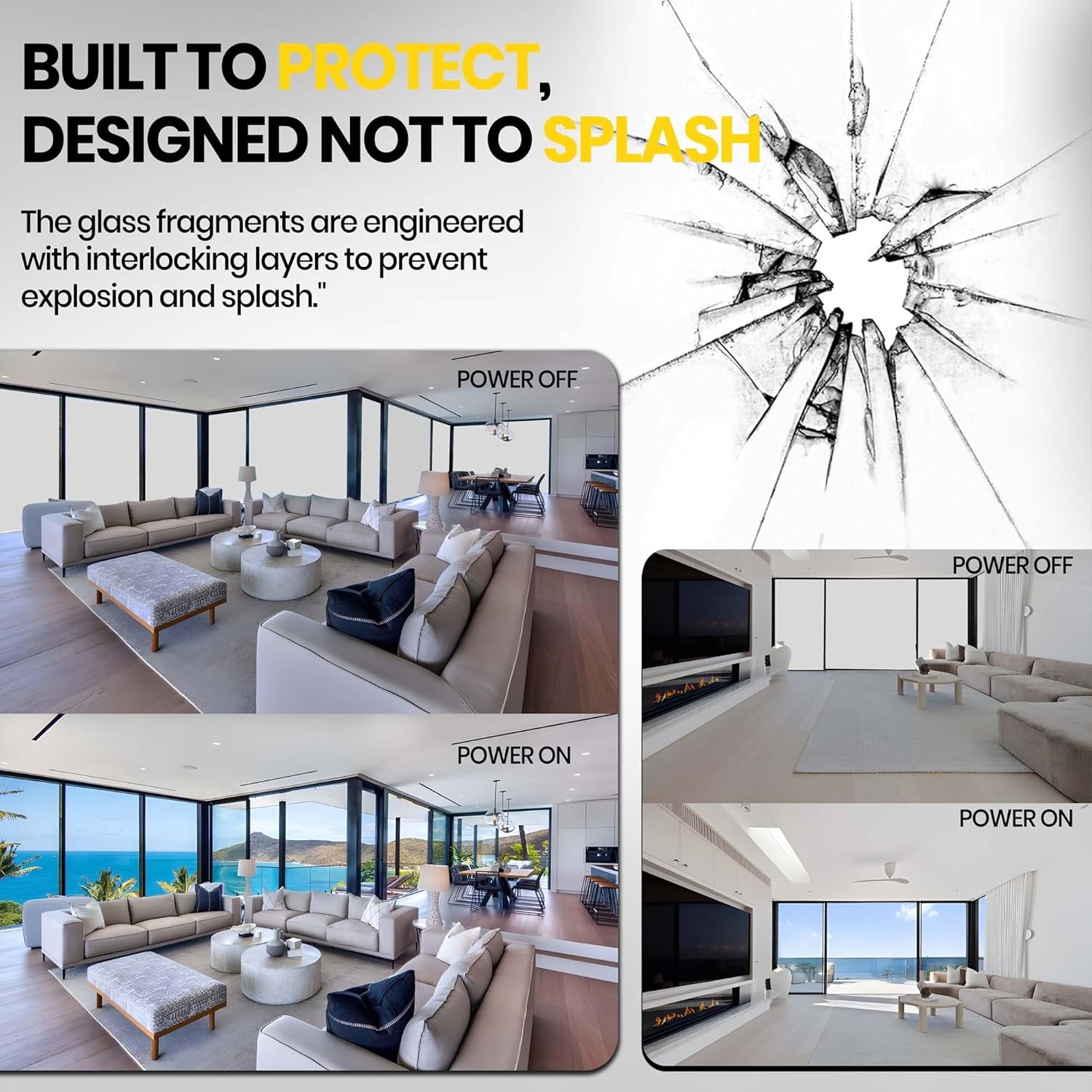
This technology enables switching between transparent and opaque states based on the electric field response of liquid crystal molecules; it features a response time of 0.02 seconds and manageable costs, capturing a 58% share of the architectural partition market.
Shenzhen JiSu Smart Tech Co., Ltd. is currently developing a solution that replaces the ITO conductive layer with silver nanowires, reducing sheet resistance to below 8 Ω/sq and further lowering material costs.
Hybrid Dimming Technology: Multimodal Response and Precise Control
Hybrid Dimming Glass—integrating electrochromic, photochromic, and thermochromic principles—has become a focal point of research and development; for instance, “four-state glass” developed in the laboratory can simultaneously respond to light, temperature, and voltage signals, enabling independent control of light transmittance, reflectance, and thermal emissivity.
📈 Market Landscape: Construction-Led
The smart glass market is characterized by a foundation in the construction sector alongside growth across multiple application areas:
Construction Sector: Large-Scale Adoption Driven by Policy
The construction industry represents the largest application market for smart glass, accounting for over 60% of the total market share. According to regulations from the Ministry of Housing and Urban-Rural Development, the use of energy-efficient materials will be mandatory for new public buildings starting in 2025; furthermore, linking green building certifications (such as LEED) to the use of smart glass has significantly stimulated market demand.
In 2024, the Phase II project of the Shanghai Tower adopted an electrochromic curtain wall, achieving an annual energy saving rate of 18% and a reduction of 1,200 tons of carbon emissions, thereby setting an industry benchmark. The market size for smart glass in construction is projected to reach RMB 11 billion by 2026, with market penetration expected to exceed 30% by 2030.
Specific application scenarios include: curtain walls for super-high-rise buildings (reducing air-conditioning loads through dynamic light regulation), smart homes (integrated with building management systems for whole-house light and thermal management), and medical facilities (privacy protection in operating rooms and patient wards).
🎯 Trends, Opportunities, and Challenges
Future Trends
Gradual cost reduction: Smart Glass costs are projected to drop by 25% by 2028, further driving market penetration in the mid-to-low-end construction and residential sectors.
Standardization: In 2025, the Standardization Administration of China will initiate the formulation of “Technical Specifications for Smart Glass,” standardizing 22 performance indicators and regulating market order.
Cross-sector integration: Deep integration with artificial intelligence (AI), the Internet of Things (IoT), and building management systems (BMS) to create new value propositions (e.g., integrated solutions linking smart glass with battery thermal management systems).
Overseas opportunities: There is urgent demand for energy-efficient building solutions in tropical Southeast Asia; in 2024, Shenzhen JiSu Smart Tech Co., Ltd. secured a government project order in Thailand.
Challenges and Breakthroughs
Key Challenges: High costs driven by the scarcity of premium raw materials (such as Indium Tin Oxide/ITO); issues such as coating delamination and uneven discoloration during long-term cycling, which urgently require resolution through improvements in interface engineering and encapsulation technologies.
Breakthrough Strategies: Exploring alternative conductive materials like carbon nanotubes and silver nanowires; enhancing product reliability through interface engineering and encapsulation technologies; and accelerating the standardization process.
Post time: 8 月-10-2026